
HOLEX Policy Director Sue Pember responds to an article in the Financial Times.
Her published letter highlights the role of adult education in fostering social cohesion in addition to its significant role relating to economic growth.
Letter to the Editor
Wider Role of Adult Education and Skills
Dear Editor,
Your recent article on the “UK skills crisis holding back growth” by Peter Foster, Amy Borrett and Anna Gross aptly highlighted the significance of adult education and skills development for economic growth. However, it is crucial to also emphasise adult education’s equally important role in fostering social cohesion—a dimension often overlooked in discussions about education policy.
For years, adult educators have warned of the dire consequences of cutting over £1 billion annually from the adult skills budget. Compared to 2009, 1 million less adults now participate in adult education, training and skills development. These cuts have resulted in reduced productivity, a lack of qualified staff, increased reliance on overseas labour, poorer social integration and civil unrest. While it’s challenging to directly link these outcomes to specific budgetary decisions, the fact remains that our underinvestment in adult education has left us trailing behind other nations.
Beyond economic imperatives, adult education plays a vital role in narrowing economic disparities, reducing social fragmentation, and fostering inclusivity. It offers marginalised groups, including immigrants and minorities, a pathway to integration through language skills and cultural knowledge. These programmes break down barriers, foster understanding, and create new social networks that strengthen communities.
Moreover, adult education equips individuals with the skills needed to navigate rapid economic and social changes. Lifelong learning enhances personal development and well-being, critical components of a cohesive society. Additionally, civic education, often embedded in adult learning programmes, empowers citizens to engage more actively in democratic processes, further strengthening community bonds. In today’s world, where adaptability is key, the role of adult education extends far beyond employability. It helps build a more resilient, informed, and engaged society, capable of managing social change and reducing the risk of unrest. We must ask ourselves: what are the long-term costs of not investing in adult education?
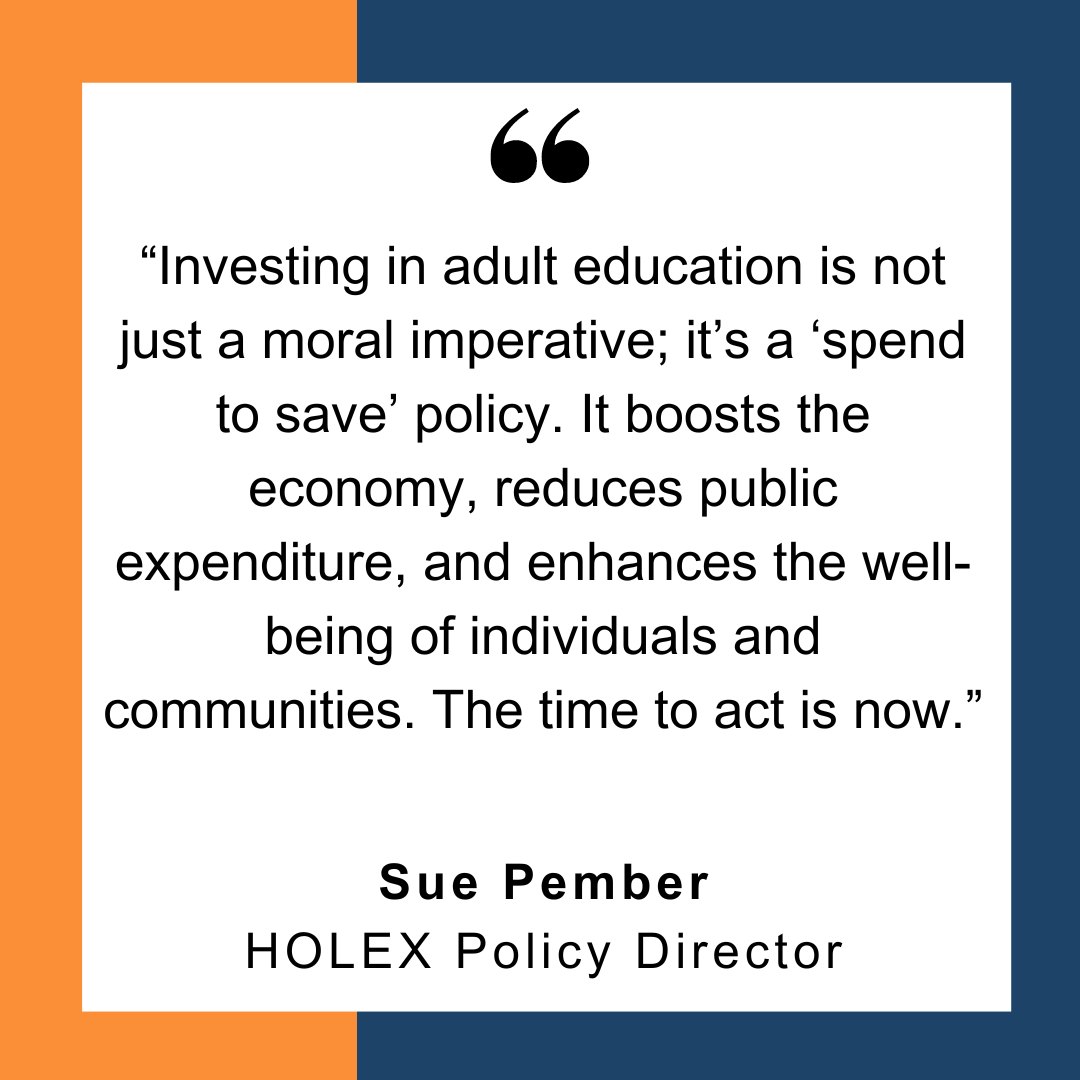
Investing in adult education is not just a moral imperative; it’s a “spend to save” policy. It boosts the economy, reduces public expenditure, and enhances the well-being of individuals and communities. The time to act is now.
Yours faithfully,
Dr Susan Pember CBE, Policy Director, HOLEX
E: sue.pember@holex.org.uk T: 07585958953
Published letter available here (only accessible if you have a paid subscription to the Financial Times).