
Digital ACE Developing Digital Resources Guidance Materials
The Digital ACE Developing Resources guidance has been drafted to help providers develop their technological solutions, skills, capabilities and policy infrastructure. The project aims to provide guidance materials, training and support which will help providers develop their digital capability and enhance their offer so that it meets the specific contexts of their local provision in line with a national high-quality approach.

Developing Digital Resources Guidance Materials
Annexes
Click on the below links to download our customisable annexes. These are available for you to ‘adopt and adapt’.
Annex 1 – The 7 Cs of Classroom Climate from Visible Learning by John Hattie
Annex 2 – Buckinghamshire Adult Learning – How Google Classroom and Google Meet can help support the delivery of online learning
Annex 3 – Buckinghamshire Adult Learning’s G-suite for online teaching and learning
Annex 4 – Newcastle City Learning (Newcastle City Council) – Online pedagogy and sharing practice
Annex 5 – Newcastle City Learning (Newcastle City Council) – Teaching Presence & Student Engagement
Annex 6 – Buckinghamshire Adult Learning has collated links for ‘Getting feedback from your learners’
Annex 7 – Newcastle City Learning (Newcastle City Council) – Guide to being clued up on copyright
Annex 8 – Introductory slides on SCULPT which is guidance for staff to create accessible documents for clients, learners and the public developed by staff at Worcestershire County Council. See also, www.worcestershire.gov.uk/sculpt
Annex 9 – Buckinghamshire Adult Learning – links for online communication
Annex 10 – Manchester Adult Education Service’s (draft) blended learning model
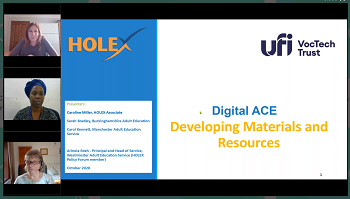
Developing Digital Resources Webinar
Developing Digital Resources – YouTube tutorials
Getting your staff started
Eduardo Saldana talks about getting your staff started with online learning. This session considers what you need to get staff started, what your staff need to be successful, how you can support your staff and continuous improvement for your service.
Blended Learning for ACE Courses
Jo Loss talks about using blended learning for ACE courses. The session considers what we mean by blended learning and the different models, why we should use this approach and considers some tips and tools.
.
Setting up a Helpline
Eduardo Saldana talks us through the process of setting up a helpline. The session considers what a helpline is and what this means to your service. It also looks at what help your learners need, what method of helpline might best suit your learners and what boundaries might be required in order for a helpline to be effective.
The Flipped Online Classroom
Jo Loss talks about the flipped online classroom. This session considers what we mean by flipped learning, the benefits and some suitable tools and strategies.
Introduction to Using Collaborative Tools for Teaching Online
Eduardo Saldana introduces us to the use of Collaborative Tools for Teaching Online. The session considers advantages and disadvantages of using collaborative tools and talks about some tools that you can use to collaborate with learners and staff.
.
Using Video in Online and Blended Learning
Eduardo Saldana talks about how to maximise your use of video in online and blended learning. The session considers the advantages and disadvantages of this approach and considers questions you should ask before using video and case studies.
Moving staff towards expert
Sarah Bradley talks about moving Staff to Expert in the context of online teaching. The session considers your starting points and the benefits of upskilling staff. It thinks about barriers and whether you are maximising expertise within your service, considers a case study from Buckinghamshire Adult learning and offers practical steps and tips.